The Correct Order to Layer Your Skincare
Skincare layering follows one rule that covers most situations: go from thinnest to thickest. Watery products go on first. Creams, oils and sunscreen go on last. A thick cream applied first sits on top of the skin and makes it harder for a light serum to spread underneath it.
Here is a simple order for morning and evening, and what to do about the products that do not fit neatly.
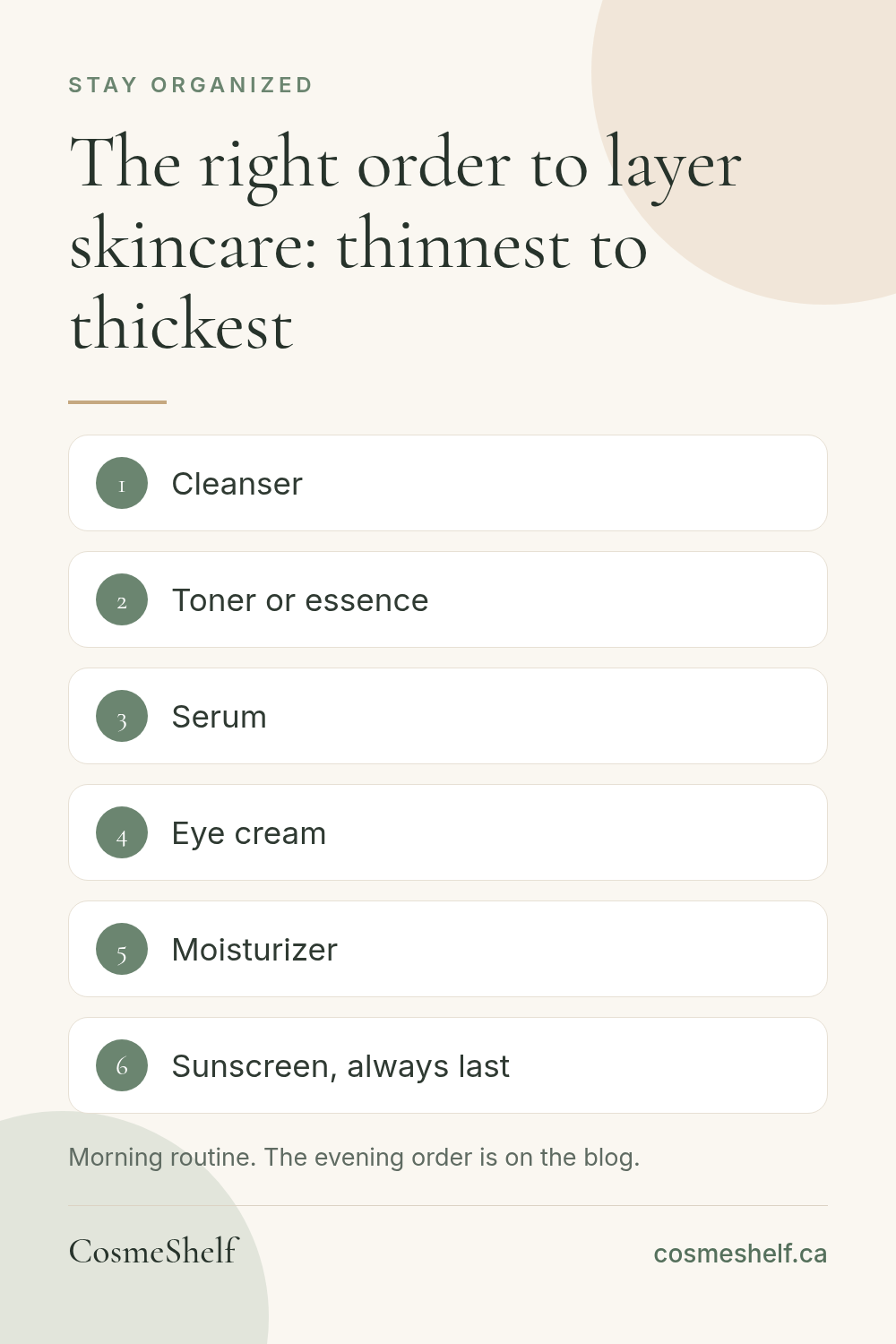
Morning routine order
- Cleanser, or just a rinse with water if your skin is dry.
- Toner or essence, if you use one.
- Serum, for example vitamin C or a hydrating serum.
- Eye cream, if you use one.
- Moisturizer.
- Sunscreen, as the last skincare step, before any makeup.
Sunscreen goes last because it is meant to form an even layer on the surface of your skin. Putting other products over it can thin that layer out.
Evening routine order
- Makeup remover or cleansing oil, if you wore makeup or sunscreen.
- Cleanser.
- Toner or essence, if you use one.
- Treatment, such as retinol or an exfoliating acid. Follow the instructions on the product.
- Moisturizer.
- Facial oil or sleeping mask, if your skin feels dry.
Where do treatments go?
Treatments such as retinol, exfoliating acids and prescription creams usually go on clean skin after cleansing and before moisturizer. If your skin is sensitive, some people apply moisturizer first and the treatment on top to soften its effect. If a doctor or pharmacist gave you the product, follow their instructions over any general guide.
Try not to add several strong treatments on the same night. Using retinol and an exfoliating acid together is a common cause of dryness and stinging. Alternating nights is the usual approach. We cover one popular pairing in retinol and vitamin C: can you use both?
How long to wait between layers
You do not need a timer. Give each layer a moment to stop feeling wet before you add the next one. Sunscreen is the one worth a short pause: let your moisturizer settle so the sunscreen spreads evenly.
Keep it short enough to do every day
A long routine you do twice a week does less for your skin than a short one you do every day. Cleanser, moisturizer and sunscreen in the morning, and cleanser and moisturizer at night, is a complete routine. Add one product at a time and give it a few weeks, so that if your skin reacts you know which product caused it.
If you are just starting out, our K-beauty routine for beginners shows how to build up from the basics.
Keeping track of what you are using
Once a routine has more than four or five products, it gets hard to remember what you opened and when. Listing your morning and evening products in one place, on paper or in an app, makes it easier to see what you really use and which bottles have been open the longest.
Track your skincare with CosmeShelf
Scan, organise, finish. Never waste a bottle again.
Try CosmeShelf free — no account neededKeep reading
How to Read Cosmetic Batch Codes
What the little stamped code on your products means, and what it can and cannot tell you.
Skincare TipsCosmetic Expiry Dates vs PAO: What's the Difference?
Expiry date, manufacture date and the open-jar symbol each mean something different.
Skincare TipsHow to Find the Manufacture Date of Skincare Products
Where to look, what to type, and what to do when the date is hidden.