How to Organize Your Skincare and Makeup Collection
A beauty collection grows quietly. A gift set here, a sample there, and one day you cannot find the moisturizer you use every morning. Organizing it takes one afternoon. Keeping it organized takes a few small habits. Here is a method that works whether you own fifteen products or a hundred and fifty.
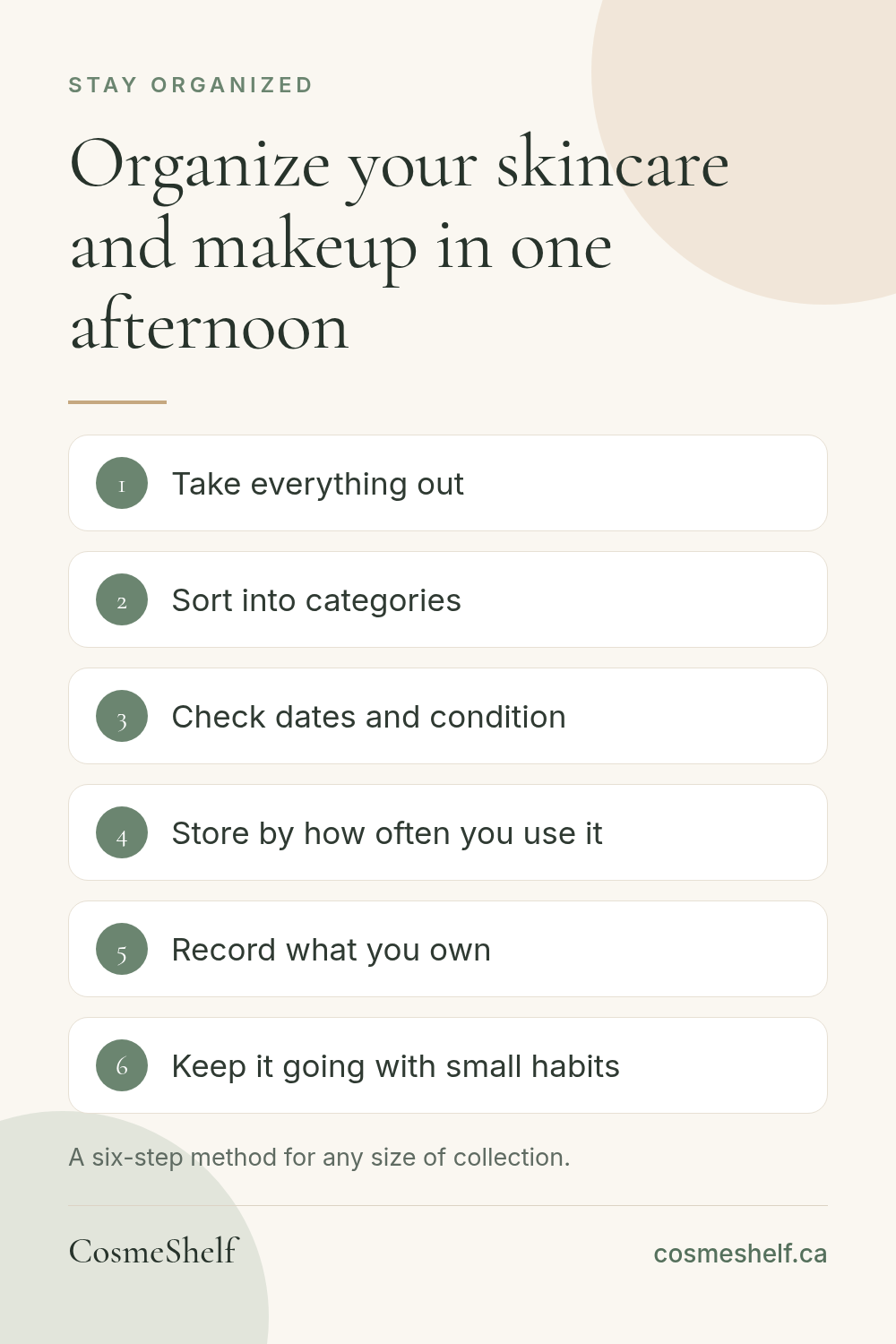
Step 1: Take everything out
Empty every place you keep products: the bathroom cabinet, the vanity, your makeup bag, your gym bag, the travel pouch, the drawer by the bed. Put it all on one surface. Seeing the whole collection at once is the step that changes how you think about it.
Step 2: Sort into categories
Make piles by type:
- Skincare: cleansers, toners, serums, moisturizers, masks, sunscreen.
- Face makeup: foundation, concealer, powder, blush, bronzer.
- Eyes: mascara, eyeliner, eyeshadow, brow products.
- Lips.
- Hair, body, nails and fragrance.
- Tools: brushes, sponges, devices.
Within each pile, put matching products next to each other. This is where duplicates show up.
Step 3: Check dates and condition
Go through each pile and look at three things: the printed expiry date if there is one, the period-after-opening symbol, and the condition of the product itself. Our guides to the PAO symbol and the signs a product has expired explain what to look for.
Then decide:
- Keep: in date, in good condition, and you use it.
- Use first: open and getting close to its limit.
- Pass on: unopened, in date, and you will not use it.
- Let go: past its date, changed, or impossible to date.
Step 4: Store by how often you use it
Give the best space to what you use daily. Your morning and evening routine products should be the easiest things to reach. Weekly items such as masks and exfoliants go one step back. Backups and occasional items go furthest away, together, where you can see them.
A few storage points that help products last:
- Keep products away from direct sunlight and heat.
- A steamy bathroom is hard on some products. If you can, keep treatments and unopened backups in a cooler, drier room.
- Store products with lids closed and upright.
- Follow any storage instructions on the label.
Step 5: Record what you own
This is the step people skip, and it is the one that keeps the collection organized. Make a list of what you kept, with the date you opened each product. A notebook, a printable inventory sheet or an app all work.
With a list you can check what you own before buying, see which products need using up first, and notice when a category has grown beyond what you can finish. On a free CosmeShelf shelf, each product shows its opening date and how long it has left, and you can look at it from your phone when you are shopping.
Step 6: Keep it going with small habits
- One in, one out. When you open a new product in a category, finish or remove an old one.
- Date it when you open it. Write the month on the product or record it straight away.
- Put things back in the same place.
- Do a ten-minute check every three months. Look at the oldest products first.
What you get from it
An organized collection saves time every morning. It also changes what you buy. When you can see that you have four cleansers, a fifth is easier to skip. For more on that, see how to stop buying beauty products you already own and how to build a skincare budget that works.
Track your skincare with CosmeShelf
Scan, organise, finish. Never waste a bottle again.
Try CosmeShelf free — no account neededKeep reading
How to Read Cosmetic Batch Codes
What the little stamped code on your products means, and what it can and cannot tell you.
Skincare TipsCosmetic Expiry Dates vs PAO: What's the Difference?
Expiry date, manufacture date and the open-jar symbol each mean something different.
Skincare TipsHow to Find the Manufacture Date of Skincare Products
Where to look, what to type, and what to do when the date is hidden.